


Hospital Capacity Management Solutions Market Summary
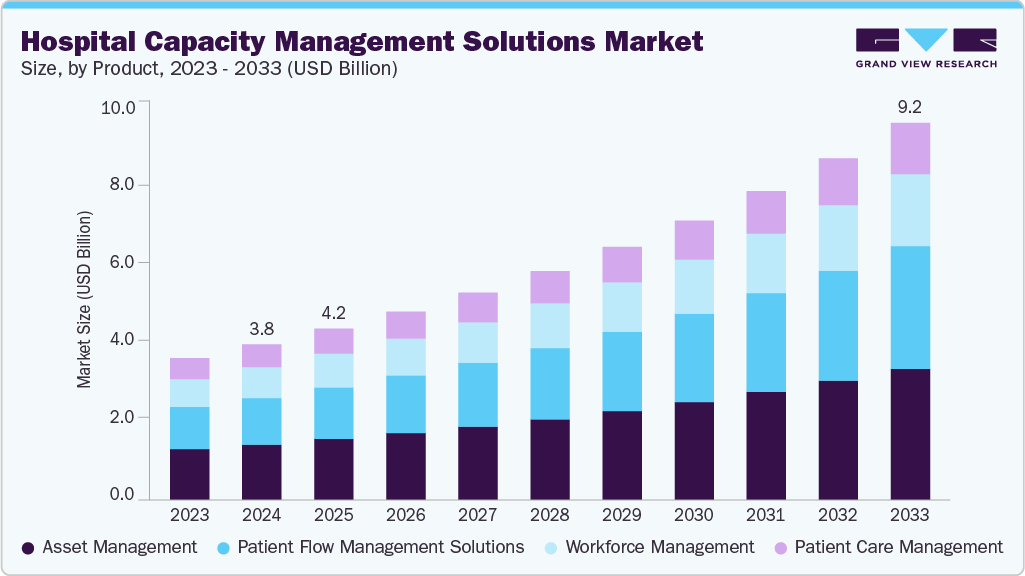
The global hospital capacity management solutions market size was estimated at USD 3.80 billion in 2024 and is projected to reach USD 9.21 billion by 2033, growing at a CAGR of 10.39% from 2025 to 2033. Rising patient volumes and bed shortages, the increasing need for operational efficiency, and a shift toward value-based care models are some of the factors contributing to market growth.
Key Market Trends & Insights
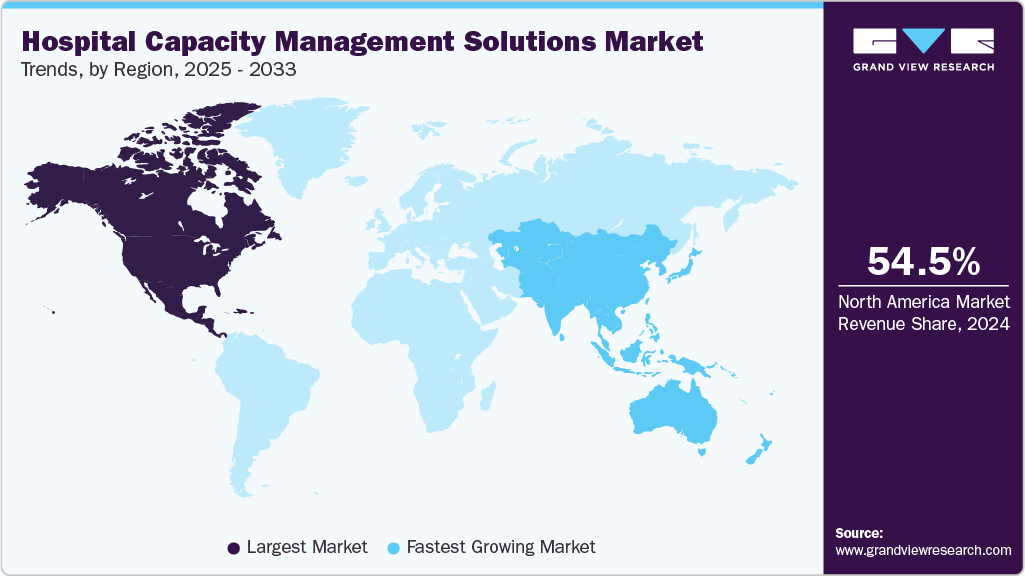
- The North America hospital capacity management solutions industry held the largest global market share of 54.51% in 2024.
- The U.S. hospital capacity management solutions industry has witnessed significant growth, fueled by advanced hospital networks, regulatory pressures, and the need to manage high patient volumes.
- Based on product, the asset management segment held the largest market share of 35.66% in 2024.
- Based on component, the software segment dominated the market with the largest revenue share of 64.74% in 2024.
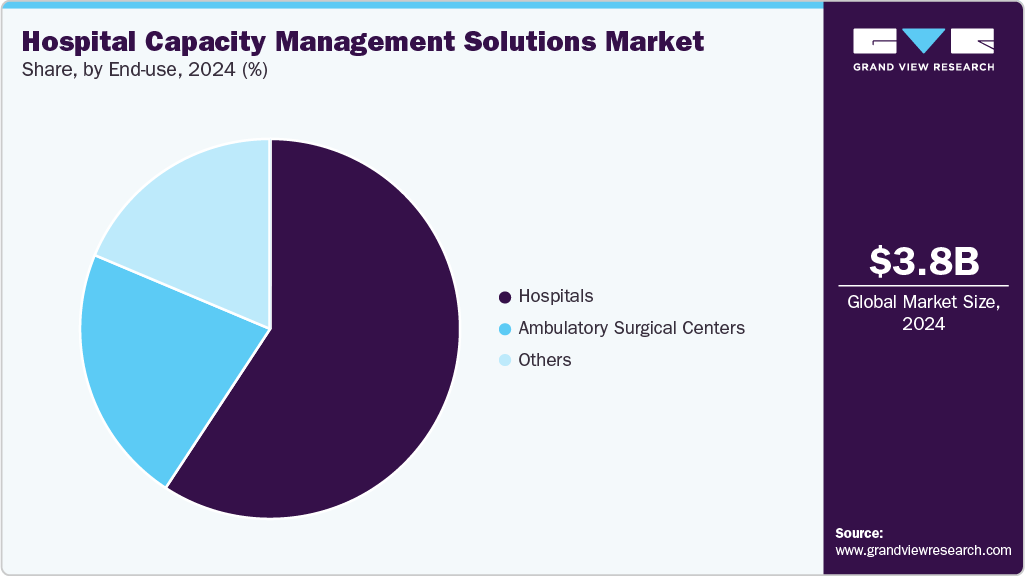
- Based on end-use, the hospitals segment dominated the market with the largest revenue share of 59.24% in 2024.
Market Size & Forecast
- 2024 Market Size: USD 3.80 Billion
- 2033 Projected Market Size: USD 9.21 Billion
- CAGR (2025-2033): 10.39%
- North America: Largest market in 2024
- Asia Pacific: Fastest growing market
In addition, the growing adoption of digital health and IoT integration and the integration of advanced analytics and AI are other factors fueling market growth. One major factor driving the hospital capacity management solutions industry is the steady increase in patient volumes. This growth is attributed to factors such as population growth, an aging population, and the rising prevalence of chronic diseases. Hospitals face a continuous patient inflow, requiring timely access to medical care, necessitating efficient management of hospital resources such as beds, medical staff, equipment, and rooms.
Capacity management solutions enable hospitals to optimize these resources by reducing wait times, improving bed turnover rates, and facilitating seamless patient flow from admission through discharge. This growing healthcare demand pushes hospitals to adopt digital tools and intelligent systems to manage capacity effectively, enhancing overall healthcare delivery and patient satisfaction.

Moreover, expanding and modernizing healthcare infrastructure worldwide drives the demand for hospital capacity management solutions. Governments and private healthcare providers are substantially investing in building new hospitals and expanding existing facilities to meet the surging demand for quality healthcare services. For instance, in February 2024, Skanska USA completed a USD 560 million hospital tower, the Petrocelli Surgical Pavilion, for North Shore University Hospital in Manhasset, New York. The 288,000-square-foot facility includes 18 operating rooms and 132 intensive care units, enhancing critical care capacity. The hospital treats over 90,000 patients annually and has 756 licensed beds, making this a major healthcare infrastructure expansion. Such infrastructure extensions increase the complexity of managing capacity across multiple locations and departments. As a result, healthcare institutions are increasingly implementing capacity management platforms to maximize resource utilization, enable real-time bed availability tracking, and coordinate patient transfers.
Healthcare organizations are increasingly focused on optimizing administrative processes, including patient scheduling, workforce allocation, and equipment management, to minimize operational hindrances and reduce the risk of medical errors. Advanced capacity management solutions leveraging automation, data analytics, and predictive modeling enable these institutions to identify inefficiencies and execute targeted enhancements that improve overall productivity.
Capabilities such as real-time tracking of bed occupancy, patient movement, discharge planning, and waitlist management enable hospitals to reduce overcrowding and maintain smooth operations even during peak demand periods. Advanced capacity management tools use AI and machine learning (ML) to predict peak admission periods, estimate resource needs, and automate capacity allocation, empowering clinicians and administrators to act rapidly.
By managing patient flow more efficiently, hospitals are able to reduce delays, minimize cancellations, and improve clinical outcomes. For instance, in August 2025, Xsolis launched Dragonfly Navigate, an AI-powered workflow solution to optimize hospital length of stay by enhancing discharge planning and capacity management. The platform predicts discharge dates early, automates AI-driven alerts, and integrates bi-directionally with EMRs to streamline clinical workflows.
“Dragonfly Navigate provides a seamless workflow that complements clinical expertise and supports more proactive discharge planning, which will give my teams more time to focus on addressing patient needs.”
–Debbie Ashworth, Executive Director of Care Management at West Tennessee Healthcare
Market Concentration & Characteristics
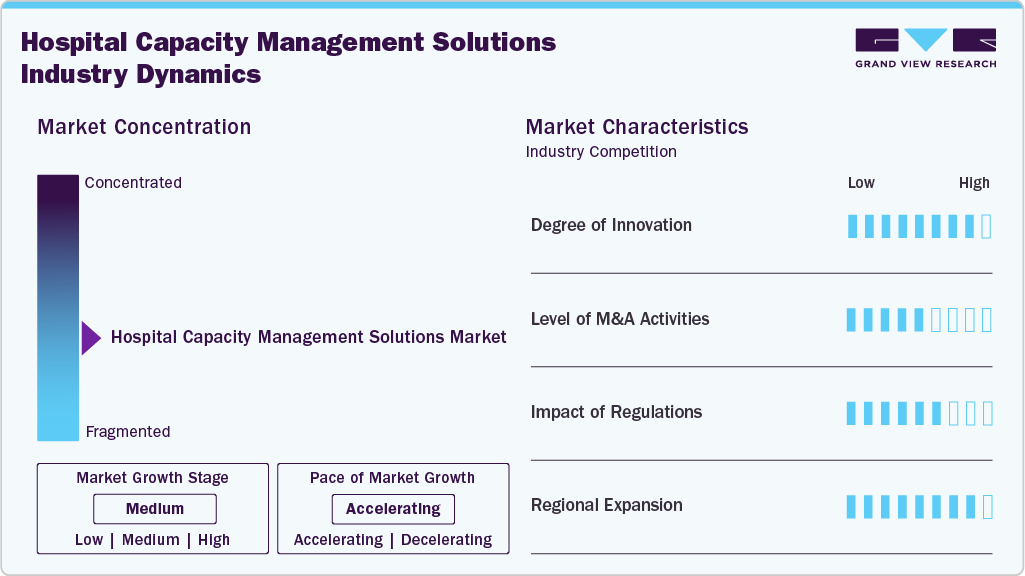
The chart below illustrates the relationship between market concentration, industry characteristics, and industry participants. The x-axis represents the level of industry concentration, ranging from low to high. The y-axis represents various industry characteristics, including industry competition, level of partnerships & collaborations activities, impact of regulations, and geographic expansion. The hospital capacity management solutions industry is fragmented, with many small players entering the market and offering new products. The regional expansion of the market is high. Moreover, the level of merger and acquisition activities and the impact of regulations is medium.
Degree of Innovationin the hospital capacity management industry is high.Market players are integrating AI and predictive analytics into hospital capacity management solutions, allowing real-time forecasting of admission rates, discharge timelines, and resource availability. For instance, in February 2025, Kontakt.io launched Rapid Room Turnover, an AI-powered solution using real-time location systems (RTLS) and IoT to automate patient discharge workflows. It detects discharges via BLE tags, notifying cleaning staff immediately to accelerate room cleaning, increasing bed capacity, and reducing typical discharge wait times by up to 50%.
“The Rapid Room Turnover solution helps hospitals unlock faster ROI through greater capacity while freeing up nurses from tedious admin tasks to focus on bedside care.”
-Rom Eizenberg, Chief Revenue Officer and Head of Product Innovation, Kontakt.io.
The industry is experiencing a moderate level of merger and acquisition activities undertaken by several key players. This is due to the desire to gain a competitive advantage in the industry, enhance technological capabilities, and consolidate in a rapidly growing market.
Regulations play a crucial role in the market by establishing standards for data security, interoperability, and patient privacy. For instance, legislation such as HIPAA mandates stringent protocols to protect sensitive health data, constraining providers to adopt advanced capacity management solutions that adhere to these regulatory frameworks.
The impact of regional expansion in market is high. Several market players are involved in geographical expansion to enhance capabilities and have a direct presence in countries that have high demand. For instance, in August 2024, Nebraska Methodist Health System selected QGenda for healthcare workforce management. This selection is expected to enhance system-wide scheduling, time, and attendance for all 650 physicians and over 8,000 nurses, aiming to improve operational efficiency and streamline processes. In addition, the increasing construction of new hospitals across the globe further contributes to market growth.
Product Insights
Based on product, the asset management segment held the largest market share of 35.66% in 2024. Asset management includes tracking, monitoring, and optimizing the use of high-value hospital resources such as medical equipment, beds, and surgical instruments. Asset management solutions, often enabled by RFID, IoT, and real-time location systems, provide visibility into equipment availability and usage patterns. In addition, these solutions reduce the need for unnecessary purchases by preventing redundancy and improving maintenance schedules.
The patient flow management solutions segment is expected to grow at the fastest CAGR over the forecast period. The patient flow management segment is designed to streamline patient movement across different hospital departments, from admission to discharge. Inefficient patient flow often results in overcrowded emergency rooms, delayed transfers, and prolonged wait times, negatively impacting care quality and patient satisfaction. By optimizing patient journeys, hospitals are able to improve discharge planning, minimize readmissions, and elevate the overall care experience.
Delivery Mode Insights
The web-based segment dominated the market with the largest revenue share of 53.18% in 2024. The web-based segment is gaining traction as hospitals seek cost-effective, easily deployable capacity management solutions. Unlike traditional on-premises systems, web-based platforms require minimal infrastructure investments and can be accessed through standard browsers without complex installations. This accessibility allows staff across departments to monitor bed availability, patient flow, and asset usage in real time, regardless of location. In addition, web-based capacity management solutions enable smooth integration with electronic health records, scheduling systems, and other hospital IT platforms. This interoperability ensures that patient data, resource availability, and operational insights are unified on a single interface.
The cloud-based segment is expected to grow at the fastest CAGR during the forecast period. This segment is expanding rapidly as hospitals prioritize flexibility and real-time access to critical operational data. Cloud platforms also support advanced analytics and predictive modeling by seamlessly integrating large volumes of data. By combining cost efficiency with reliable security, cloud-based solutions are becoming a preferred choice for hospitals undergoing digital transformation.
Component Insights
The software segment dominated the market with the largest revenue share of 64.74% in 2024. This segment is crucial in hospital capacity management as it offers centralized platforms integrating patient flow, bed management, staff allocation, and asset tracking into a single system. These solutions reduce fragmentation by connecting multiple departments, ensuring that resources are used efficiently across the hospital.
Hospital capacity management software is designed to integrate seamlessly with electronic health records, billing platforms, and telehealth systems, creating a unified digital ecosystem. Such interoperability enables hospitals to customize workflows based on their specific size, patient mix, and care delivery model.
Moreover, the services segment is expected to register the fastest CAGR during the forecast period. Hospitals often require expert assistance for system installation, customization, and integration with existing IT infrastructure. Service providers also deliver training programs to ensure staff are able to use the platforms for real-time decision-making effectively. Beyond initial deployment, the services segment covers continuous monitoring, software updates, and technical support to maintain system reliability. Hospitals depend on these services to address evolving operational challenges and regulatory requirements. Beyond initial deployment, the services segment covers continuous monitoring, software updates, and technical support to maintain system reliability. Hospitals depend on these services to address evolving operational challenges and regulatory requirements.
End-use Insights
Based on end use, the hospitals segment dominated the market with the largest revenue share of 59.24% in 2024. Hospitals represent the largest end users of capacity management solutions due to their complex operations and high patient inflow. These institutions face constant challenges balancing bed occupancy, emergency admissions, and scheduled procedures.
Capacity management tools help streamline workflows by offering real-time visibility into bed status, equipment availability, and staff allocation. Adopting these systems also enables compliance with quality benchmarks and regulatory standards. For instance, in December 2024, Memorial Healthcare System launched its Care Coordination Center (CCC), a 24/7 clinical command center using virtual operations and artificial intelligence (AI) technology to improve patient safety and efficiency across its six facilities. Equipped with advanced dashboards and Epic EHR integration, the center leverages capacity management, improving overall clinical and operational outcomes in South Florida.
The ambulatory surgical centers segment is anticipated to grow at the fastest CAGR from 2025 to 2033. The shift toward minimally invasive surgeries and shorter recovery times has significantly increased patient preference for ambulatory surgical centers. Ambulatory surgical centers are increasingly adopting capacity management solutions to streamline scheduling, optimize resource allocation, and reduce procedural delays. These centers operate with limited staff and infrastructure compared to large hospitals, making efficient utilization of resources critical.
Regional Insights
The North America hospital capacity management solutions industry held the largest global market share of 54.51% in 2024. This is attributed to the advanced healthcare infrastructure, early adoption of digital health technologies, and strong emphasis on operational efficiency. Government initiatives supporting interoperability and digital transformation in healthcare further accelerate adoption. In the U.S., regulatory frameworks such as CMS quality reporting demand effective capacity optimization. Canada’s emphasis on optimizing resource allocation within publicly funded systems drives increased investments in healthcare IT. Mexico is seeing growth driven by the modernization of hospital IT systems in urban centers.
U.S. Hospital Capacity Management Solutions Market Trends
The U.S. hospital capacity management solutions industryhas witnessed significant growth, fueled by advanced hospital networks, regulatory pressures, and the need to manage high patient volumes. The presence of leading technology providers and health IT vendors fosters rapid innovation and adoption. The growing emphasis on predictive analytics and AI-powered tools further contributes to market growth.
Europe Hospital Capacity Management Solutions Market Trends
The Europe hospital capacity management solutions industry is supported by the strong regulatory standards, cross-border healthcare collaboration, and rising focus on cost containment. National health systems in countries such as the UK, Germany, and France are investing heavily in digital hospital infrastructure. EU-level initiatives promoting interoperability are encouraging hospitals to adopt integrated capacity management tools, further fueling market growth.
Germany’s hospital capacity management solutions industry is propelled by its large healthcare infrastructure and comprehensive insurance coverage systems. The country’s push toward digital health adoption under the Digital Healthcare Act encourages investments in smart hospital management. Implementation of electronic patient records and health data interoperability supports real-time resource management. Moreover, the emphasis on data security and compliance with strict regulatory frameworks drives demand for robust systems.
The UK hospital capacity management solutions industry is driven by the National Health Service (NHS) initiatives to modernize hospital infrastructure and reduce waiting times. The NHS Long Term Plan emphasizes digital transformation, creating opportunities for advanced capacity management tools. The UK’s strong regulatory environment also supports the standardization of healthcare IT systems. Workforce shortages and high emergency admissions increase reliance on digital platforms for efficiency. Such factors establish the UK as a leading European market for capacity management solutions.
Asia Pacific Hospital Capacity Management Solutions Market Trends
Asia Pacific hospital capacity management solutions industry is expected to witness the fastest growth over the forecast period. This growth is attributed to the increasing digitalization of healthcare systems, government initiatives promoting healthcare IT adoption, and improving patient care quality and safety. In addition, growing focus on improving operational efficiency and the need for better data management and interoperability across hospitals are anticipated to drive market demand over the coming years.
Japan’s hospital capacity management solutions industry is driven by the country’s growing geriatric population, which significantly increases demand for acute and long-term care beds. In addition, the government’s digital transformation initiatives are promoting the adoption of smart hospital technologies. AI-driven platforms improve patient flow and resource efficiency in high-volume hospitals. Moreover, integration with electronic health records and telemedicine systems further strengthens demand.
India hospital capacity management solutions industry is expanding rapidly, driven by growing healthcare demand, government-backed digital health programs, and increasing private sector investments. Initiatives under Ayushman Bharat and the National Digital Health Mission encourage the adoption of smart hospital technologies. The rise of multi-specialty hospital chains and private healthcare networks further accelerates adoption. Cloud-based solutions are gaining traction due to affordability and ease of deployment in resource-constrained settings.
Latin America Hospital Capacity Management Solutions Market Trends
Latin America hospital capacity management solutions industry growth is driven by improving healthcare infrastructure and rising demand for quality care access. Investments in hospital modernization and digital health programs across countries such as Brazil and Argentina enhance care coordination and resource allocation capabilities. The prevalence of communicable and non-communicable diseases escalates the burden on hospital systems, emphasizing the need for efficient patient throughput management.
Middle East & Africa Hospital Capacity Management Solutions Market Trends
The Middle East and Africa hospital capacity management solutions industry is supported by increasing investments in healthcare infrastructure, especially in Gulf Cooperation Council (GCC) countries. Governments are prioritizing smart hospital initiatives as part of broader digital transformation strategies. Rising medical tourism in the UAE and Saudi Arabia creates demand for efficient patient flow management.
Key Hospital Capacity Management Solutions Company Insights
Key players operating in the hospital capacity management solutions industry are undertaking various initiatives to strengthen their market presence and increase the reach of their products and services. Strategies such as new product launches and partnerships are playing a key role in propelling market growth.
Key Hospital Capacity Management Solutions Companies:
The following are the leading companies in the hospital capacity management solutions market. These companies collectively hold the largest market share and dictate industry trends.
- Oracle
- TeleTracking Technologies, Inc.
- Alcidion
- Epic Systems Corporation
- Siemens Medical Solutions USA, Inc.
- Dedalus
- Flatworld Solutions
- IQVIA
- ORTEC
- LeanTaaS
- Infosys Limited
- WellSky
Recent Developments
-
In February 2025, WellSky launched Resource Manager, a centralized workforce management platform improving home health and hospice care delivery. It optimizes patient scheduling, clinician capacity, and routing.
-
In July 2024, Qventus launched its 3rd Generation Inpatient Solution, fully embedded into EHR workflows, to optimize hospital discharge planning and automate care coordination.
-
In April 2024, Children’s Minnesota partnered with the Virginia-based staffing platform ShiftMed to address scheduling gaps within its pediatric healthcare system.
-
In September 2023, ShiftMed partnered with Hennepin Healthcare to implement on-demand W-2 workforce solutions, enhancing staffing efficiency and recruitment processes. This collaboration aims to optimize staffing ratios and provide flexible work opportunities for healthcare professionals in the Minneapolis area.
-
In June 2023, LeanTaaS launched iQueue Autopilot, the first generative AI hospital operations solution offering human-like conversations and actionable insights for patient flow, scheduling, staffing, and capacity management across inpatient and outpatient settings.
-
In January 2023, LeanTaaS acquired Hospital IQ, creating an AI-powered hospital operations innovator. Serving 180+ U.S. health systems, the combined company optimizes capacity and workflows across infusion centers, operating rooms, and inpatient units, addressing staffing shortages and improving patient access, staff satisfaction, and revenue productivity.
-
In October 2021, GE Healthcare partnered with Apprise Health Insights to launch an automated statewide hospital bed management solution in Oregon, called the Oregon Capacity System (OCS). This command center software provides near real-time occupancy and resource data across 60 hospitals, tracking 7,368 beds and 800 ventilators while processing 4.2 million data points daily.
Hospital Capacity Management Solutions Market Report Scope
|
Report Attribute
|
Details
|
|
Market size value in 2025
|
USD 4.18 billion
|
|
Revenue forecast in 2033
|
USD 9.21 billion
|
|
Growth rate
|
CAGR of 10.39% from 2025 to 2033
|
|
Actual data
|
2021 – 2024
|
|
Forecast period
|
2025 – 2033
|
|
Quantitative units
|
Revenue in USD million/billion and CAGR from 2025 to 2033
|
|
Report coverage
|
Revenue forecast, company ranking, competitive landscape, growth factors, and trends
|
|
Segments covered
|
Delivery mode, component, product, end-use, region
|
|
Regional scope
|
North America; Europe; Asia Pacific; Latin America; MEA
|
|
Country scope
|
U.S.; Canada; Mexico; UK; Germany; France; Italy; Spain; Norway; Sweden; Denmark; Japan; China; India; Australia; South Korea; Thailand; Brazil; Argentina;, South Africa; Saudi Arabia;, UAE; Kuwait
|
|
Key companies profiled
|
Oracle; TeleTracking Technologies, Inc.; Alcidion; Epic Systems Corporation; Siemens Medical Solutions USA, Inc.; Dedalus; Flatworld Solutions; IQVIA; ORTEC; LeanTaaS; Infosys Limited; WellSky
|
|
Customization scope
|
Free report customization (equivalent up to 8 analysts working days) with purchase. Addition or alteration to country, regional & segment scope.
|
|
Pricing and purchase options
|
Avail customized purchase options to meet your exact research needs. Explore purchase options
|
Global Hospital Capacity Management Solutions Market Report Segmentation
This report forecasts revenue growth at global, regional, and country levels and provides an analysis of the latest industry trends in each of the sub-segments from 2021 to 2033. For this study, Grand View Research has segmented the global hospital capacity management solutions market report based on product, delivery mode, component, end-use, and region.
- Product Outlook (Revenue, USD Million, 2021 – 2033)
-
Delivery Mode Outlook (Revenue, USD Million, 2021 – 2033)
-
Web-based
-
On-premises
-
Cloud-based
-
-
Component Outlook (Revenue, USD Million, 2021 – 2033)
-
End Use Outlook (Revenue, USD Million, 2021 – 2033)
-
Regional Outlook (Revenue, USD Million, 2021 – 2033)
Frequently Asked Questions About This Report
b. The global hospital capacity management solutions market size was estimated at USD 3.80 billion in 2024 and is expected to reach USD 4.18 billion in 2025.
b. The global hospital capacity management solutions market is expected to grow at a compound annual growth rate of 10.39% from 2025 to 2033 to reach USD 687.32 billion by 2033.
b. Software segment dominated the hospital capacity management solutions market with a share of 64.74% in 2024.
b. Some key players operating in the hospital capacity management solutions market include Oracle; TeleTracking Technologies, Inc.; Alcidion; Epic Systems Corporation; Siemens Medical Solutions USA, Inc.; Dedalus; Flatworld Solutions; IQVIA; ORTEC; LeanTaaS; Infosys Limited; WellSky.
b. Key factors that are driving the hospital capacity management solutions market growth include rising patient volumes and bed shortages, the increasing need for operational efficiency, and a shift toward value-based care models. In addition, the growing adoption of digital health and IoT integration and the integration of advanced analytics and AI are other factors fueling market growth.
link