


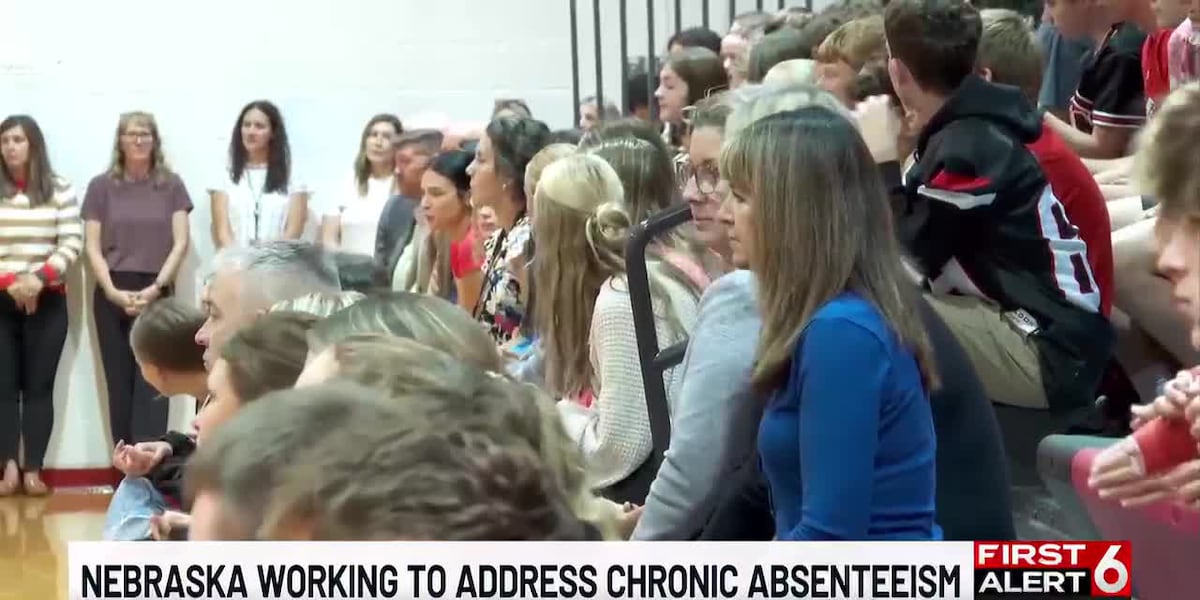
YUTAN, Neb. (WOWT) – On Friday, state leaders drew attention to chronic absenteeism in schools. It’s an issue that’s been plaguing Nebraska educators for the last five years.
Chronic absenteeism is when a student misses more than 10% of their time at school in one year. That ends up being around 15 days for more kids, excused and unexcused.
Last year, the Nebraska Department of Education estimated 68,000 Nebraska students were chronically absent from school. Their report shows students with disabilities, students of color or students who are economically disadvantaged are disproportionally affected, as well as those in early and later grades.
Today, the Nebraska Commissioner of Education and Lt. Governor presented a proclamation for attendance awareness month. The district was chosen for the proclamation because it’s improved its own attendance numbers in recent years.
“Overall, daily attendance has gone up and has continued to go up over the last few years,” said Superintendent Brett Schwartz.
He attributes much of their success to prioritizing relationships and extracurriculars for their students.
“Open communication, providing students additional support when needed – really just a large number of students who participate in either a co-curricular or an extracurricular activity, and usually when kids are connected on that level, getting to school each day is not the normal battle that it can be sometimes,” explained Schwartz.
The Nebraska Department of Education found that as little as five days of absence from school can hurt a student’s academics.
Lt. Governor Kelly told First Alert 6 it’s going to take everyone’s cooperation to improve attendance in the state.
“It’s going to take each school district looking at their numbers and trying to determine the reasons. You know, the reasons could be different in different school districts for why kids aren’t there. You got to look at poverty, you got to look at the parents, you got to look at how far it is to get to school and transportation, whatever those obstacles are. So, identify the obstacles first, and then see what the community can do.”
For Yutan, they know that programs connecting high school students with younger students and providing plenty of extra activities are what works for them, motivating kids to return each day.
According to the Nebraska Department of Education, 68,000 students were chronically absent in the state last year. Their goal is to reduce that number by at least half before 2030.
Copyright 2025 WOWT. All rights reserved.
link