

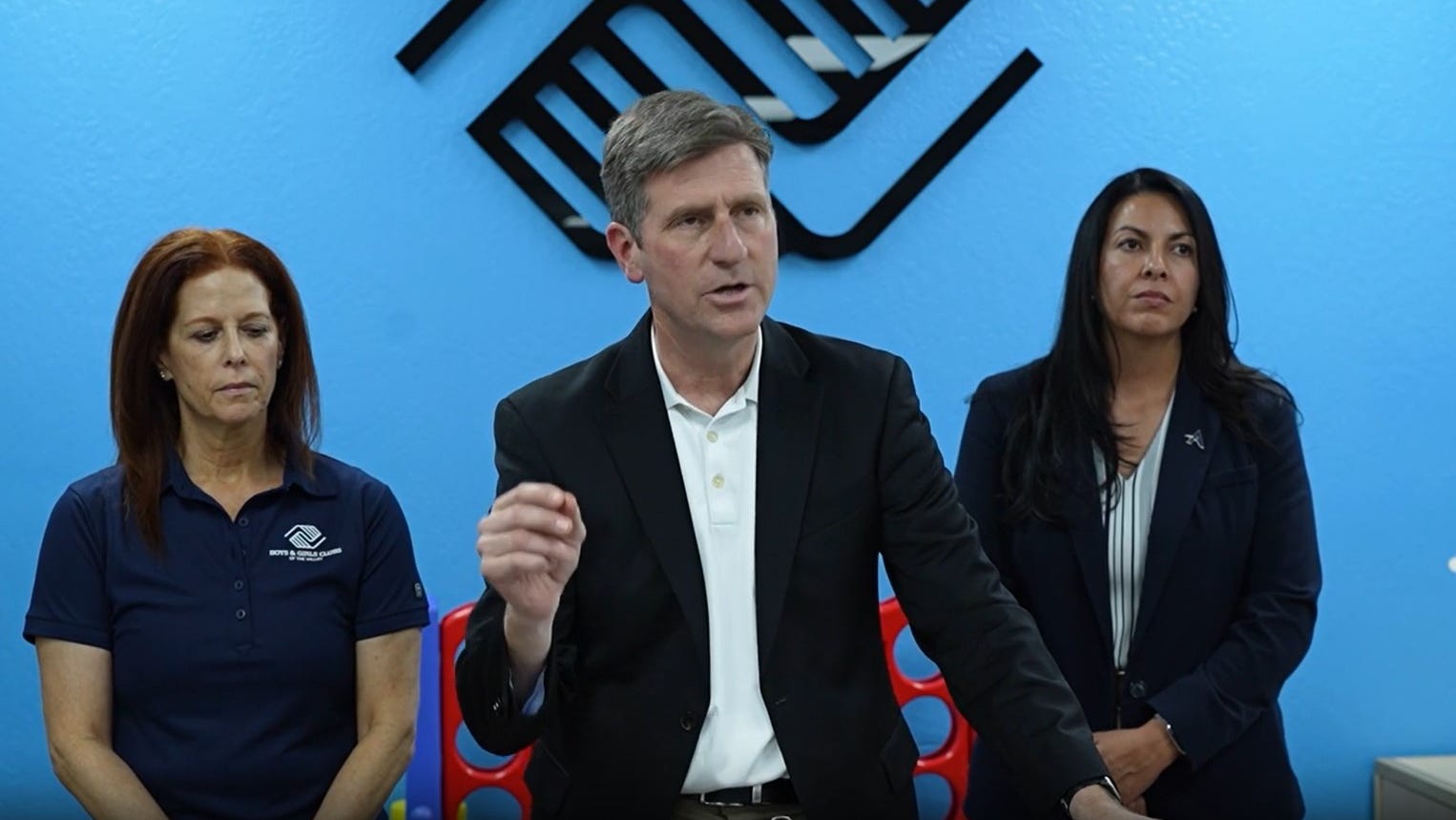

Rep. Stanton blasts Trump education cuts at Boys and Girls Club event
Stanton spoke alongside the CEO of the Boys and Girls Club of the Valley, Marcia Mintz, decrying Trump administration cuts to after-school programs.
- Arizona’s third grade reading proficiency is currently at 39% and a new plan aims to raise it to 72% in five years.
- The Arizona Literacy Plan 2030 focuses on proven solutions like teacher training, family engagement and early childhood education.
- The plan will increase the number of literacy coaches statewide, particularly in struggling schools.
Only 39% of Arizona’s third graders meet reading proficiency, and a new statewide initiative aims to get that number up to 72% within the next five years.
Arizona Literacy Plan 2030 was formulated by education stakeholders over 18 months to bring evidence-based solutions that are already being used in Arizona schools to even more students, said Terri Clark, director of literacy for Read On Arizona, which launched in 2013 to improve the state’s literacy rates for children up to age eight.
These solutions include providing teachers with the tools and science for improving literacy, family engagement. So parents know what their children are learning and making sure all learners have access to high-quality early childhood education, which about 25% of schools do not have, Clark said.
“Since the pandemic, the needs and gaps have widened so much,” she said. “We want to be laser-focused on these strong implementation strategies, not because we want to put more burden on anyone, but because we know that these work, and therefore then the burden comes off.”
Read On Arizona holds out O.C. Johnson Elementary in Yuma as a success story for rapidly boosting proficiency with evidence-based strategies. The school saw third-grade English Language Arts scores go from 16% in 2021 to 72% in 2024.
“There’s no one magic solution,” Clark said. “It is a combination of things that we need to make sure get to more students and educators and families.”
Literacy plan will deploy coaches across the state
The Arizona Department of Education, the Governor’s Office and the State Board of Education are among the public and private partners that signed on to the Arizona Literacy Plan 2030.
“Arizona Literacy Plan 2030 is a rallying cry for committing to what works,” said Sean Ross, executive director of the Arizona State Board of Education. “Evidence-based reading instruction and interventions work for all students, including English learners and students exhibiting characteristics of dyslexia.”
Read On Arizona plans to increase the number of literacy coaches deployed to schools throughout the state, especially those that scored in the bottom 10% and showed the highest number of struggling readers, Clark said.
Literacy coaches are provided by the Arizona Department of Education’s Foundational Literacy Coaching Grant. Literacy coaches provide teachers with resources to identify their students’ needs and focus on what works. Amid teacher burnout and shortages, it’s important to work smarter, not harder, said Clark.
This literacy coach model was inspired by Mississippi’s statewide initiative that helped make the state’s reading proficiency improve from 49th to 21st in the nation.
Arizona Literacy Plan 2030 available online for educators
To meet its reading proficiency goal, Read On Arizona plans to work to decrease chronic absenteeism, focus on students who are on the cusp of proficiency and make sure teachers receive their K-5 Literacy Endorsement, a state requirement for K-5 literacy teachers.
Educators can access the Arizona Literacy Plan 2030 at LitHubAZ.org. That website also houses additional resources about how to boost literacy, such as the Arizona Chronic Absence Resource Guide, which provides administrators and school staff with a step-by-step process for identifying factors that may stop students from attending class.
“The science actually says that 95% or more students can learn to read if given the proper support and service,” said Clark. “So, the 72% … is doable if we do these things at scale.”
Coverage of education solutions on azcentral.com and in The Arizona Republic is partially supported by a grant from the Arizona Local News Foundation’s Arizona Community Collaborative Fund.
link