
Key Highlights
| Study Period | 2019 – 2032 |
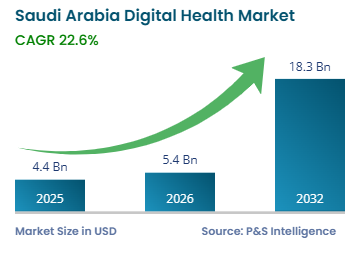
| Market Size in 2025 | USD 4.4 Billion |
| Market Size in 2026 | USD 5.4 Billion |
| Market Size by 2032 | USD 18.3 Billion |
| Projected CAGR | 22.6% |
| Largest Province | Al-Riyadh |
| Fastest-Growing Region Province | Makkah |
| Market Structure | Fragmented |
Market Size
Explore the market potential with our data-driven report
Saudi Arabia Digital Health Market Future Outlook
The Saudi Arabian digital health market size will be an estimated USD 4.4 billion for 2025, and it will grow by 22.6% during 2026–2032, to reach USD 18.3 billion by 2032.
The market growth is primarily driven by the kingdom’s Vision 2030 healthcare transformation agenda, escalating prevalence of chronic diseases among the adult population, particularly diabetes; and rapid adoption of telemedicine and artificial intelligence-powered healthcare solutions across both public and private healthcare sectors.
The digital health revolution in Saudi Arabia is being catalyzed by unprecedented government investment exceeding USD 1.5 billion, specifically allocated for healthcare information technology and digital transformation initiatives. The digital transformation is evident in landmark projects such as the Seha Virtual Hospital, which has emerged as the world’s largest virtual healthcare facility, capable of serving up to 400,000 patients annually while connecting over 224 hospitals across the kingdom. The rapid adoption of smartphones with penetration rates among the highest in the Middle East, combined with a young, tech-savvy population where 63% are under 30 years of age, creates an ideal ecosystem for digital health innovation and widespread consumer acceptance of remote healthcare solutions.
Saudi Arabia Digital Health Market Dynamics
Rapid Integration of Advanced Technologies Is Key Trend
- The rapid adoption of advanced technologies in Saudi Arabia is a key trend in the digital health market, supported by the kingdom’s strong technological infrastructure and high digital literacy rates.
- The kingdom boasts one of the highest smartphone penetration rates in the Middle East, with widespread 5G network coverage and reliable internet connectivity even in remote areas.
- As per early 2025 estimates, over 78% of the kingdom’s population has 5G, enjoying average speeds of 243.7 Mbps.
- In 2024, there were ~135 mobile broadband connections per 100 inhabitants, and mobile internet usage penetration was about 93.18% of the population.
- In 2024, the government committed USD 57.04 billion (SAR 214 billion) to health and social development, prioritizing new hospitals, health services expansion, and ambulance connectivity automation.
- This technological backbone enables seamless delivery of telemedicine services, real-time health data transmission, and cloud-based healthcare solutions across the nation.
- The development of integrated health information exchange platforms facilitates interoperability between different healthcare providers, ensuring continuity of care and enabling comprehensive health analytics.
- Healthcare facilities are increasingly adopting cloud-based electronic health records, with new implementations choosing cloud solutions for their scalability and cost-effectiveness.
- Additionally, the integration of emerging technologies such as artificial intelligence, blockchain for health data security, and Internet of Things devices for remote monitoring creates a sophisticated digital health ecosystem that attracts both domestic and international investments.
Vision 2030 Healthcare Digitalization Is Biggest Driver
- The Saudi government’s Vision 2030 initiative represents the most significant driver propelling the digital health market forward through comprehensive healthcare sector transformation.
- Under Vision 2030, the kingdom established the Saudi Data & AI Authority (SDAIA) to drive AI adoption and strategic data use, positioning itself as a global AI leader.
- Telemedicine is a key focus, with USD 1.5 billion allocated for health information technology.
- This strategic commitment has materialized through the launch of multiple national digital platforms, including Sehhaty for accessing medical records, Mawid for appointment scheduling, and Tawakkalna for integrated health services.
- These services collectively reach millions of users and demonstrate the government’s dedication to creating a fully digitized healthcare ecosystem.
- Vision 2030, with its broad scope, targets an extensive overhaul of healthcare through infrastructure enhancement, digital health adoption, workforce empowerment, innovative public health initiatives, and advancements in quality of care.
- The Health Sector Transformation Program, a key component of Vision 2030, has set ambitious targets, including the digitization of 70% of patient activities by 2030, expansion of telemedicine coverage to rural areas, and establishment of integrated health information exchange systems.
- These initiatives are supported by the Regulatory Healthcare Sandbox, which provides a secure environment for startups and companies to test and refine digital health and AI solutions before nationwide deployment.
Saudi Arabia Digital Health Market Segmentation Analysis
Technology Analysis
The telemedicine category holds the largest market share in 2025, because it enables remote consultations, virtual hospitals, and telehealth services, addressing the country’s healthcare access challenges. Government initiatives under Vision 2030, such as the Seha Virtual Hospital, along with growing patient demand for convenient, efficient, and scalable healthcare solutions, drive its dominance.
The mHealth category will have the highest CAGR, of 22.8%, driven by the widespread adoption of health and fitness apps, chronic disease management applications, and the kingdom’s exceptionally high smartphone penetration rates exceeding 90%. This dominance reflects the population’s preference for convenient, on-demand health services accessible through mobile devices, with popular applications, including diabetes management tools, medication reminders, and mental health support platforms, which have collectively garnered millions of downloads. The segment’s growth is further bolstered by partnerships between telecommunications providers and healthcare organizations to bundle health apps with mobile plans, making digital health services more accessible to diverse population segments.
The technologies analyzed in this report are:
- Mobile Health (mHealth) (Fastest-Growing Category)
- Electronic Health Records (EHR)
- Telemedicine (Largest Category)
- Healthcare Analytics
End User Analysis
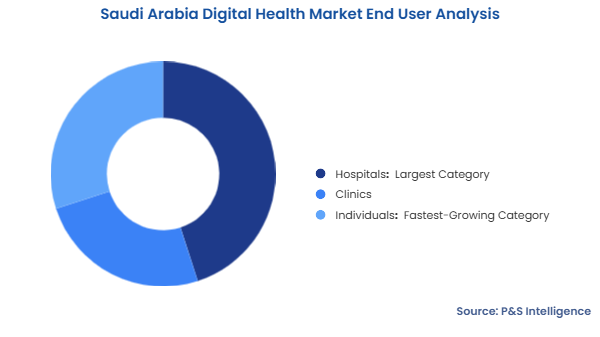
The hospitals category holds the largest market share, of 45%, in 2025, as these institutions lead the digital transformation with comprehensive implementations of integrated health information systems, telemedicine platforms, and AI-powered diagnostic tools. Major hospitals such as King Faisal Specialist Hospital and King Abdulaziz Medical City have pioneered the adoption of advanced digital health technologies, setting benchmarks for the entire healthcare sector. The hospital category’s dominance is reinforced by substantial government funding for public hospital digitization and the establishment of smart hospital infrastructure that integrates IoT devices, automated workflows, and predictive analytics for enhanced patient care delivery.
The individuals category will have the highest CAGR, of 22.9%, reflecting the paradigm shift toward consumer-driven healthcare and personal health management. This rapid growth is fueled by increasing health consciousness among Saudi citizens, rising adoption of wearable devices for fitness tracking and health monitoring, and the proliferation of direct-to-consumer digital health services. The young demographic profile of Saudi Arabia, combined with high disposable incomes and cultural shifts toward preventive healthcare, creates ideal conditions for individual adoption of digital health solutions ranging from virtual consultations to personalized wellness programs.
The end users analyzed in this report are:
- Hospitals (Largest Category)
- Clinics
- Individuals (Fastest-Growing Category)
Drive strategic growth with comprehensive market analysis
Saudi Arabia Digital Health Market Geographical Analysis
Al-Riyadh Digital Health Market Size
Al-Riyadh holds the largest market share, of 35%, in 2025, driven by its status as the capital and home to the kingdom’s most advanced healthcare infrastructure, including flagship facilities like the Seha Virtual Hospital and major medical cities implementing cutting-edge digital solutions. The province’s dominance is reinforced by the concentration of government healthcare initiatives, with Riyadh serving as the pilot location for national digital health programs before nationwide rollouts.
Riyadh leads the market due to its advanced hospital infrastructure and significant healthcare demands driven by urban growth. The Central region’s prominence is supported by its political and economic stature, fostering rapid HIS adoption. Riyadh’s thriving startup ecosystem, supported by government incubators and international partnerships, has positioned the province as the innovation hub for digital health in the kingdom. Major technology companies and global healthcare IT providers have established their regional headquarters in Riyadh, facilitating knowledge transfer and accelerating the adoption of advanced digital health solutions across public and private healthcare sectors.
Makkah Digital Health Market Size
Makkah will have the highest CAGR, of 22.7%, due to rapid healthcare digitalization initiatives and strong government support. Under Vision 2030, the Ministry of Health has prioritized digital transformation across Makkah’s hospitals to enhance medical services for both residents and the millions of Hajj and Umrah pilgrims each year. The province benefits from large-scale projects such as the Smart Health Initiative and integration with the Seha Virtual Hospital, which extends advanced telemedicine and AI-driven diagnostics to regional facilities.
The government’s Digital Health Strategy aims to enable seamless e-health records and mobile-based patient engagement in Makkah’s healthcare network. These efforts, combined with growing investments in remote monitoring and teleconsultation systems, are accelerating digital adoption, making Makkah the fastest-growing province in Saudi Arabia’s digital health landscape.
Eastern Province Digital Health Market Size
The Eastern Province represents a significant market for digital health in Saudi Arabia, driven by its strategic importance as the kingdom’s industrial heartland and the presence of major healthcare projects associated with Saudi Aramco and other industrial giants investing heavily in employee health technologies. The province’s rapid digital health adoption is catalyzed by its relatively young, educated workforce demanding modern healthcare services and the concentration of private healthcare facilities implementing advanced telemedicine and remote monitoring solutions to serve industrial workers across dispersed locations.
The Eastern Province’s growth is further accelerated by cross-border healthcare initiatives with neighboring Gulf countries and the development of smart city projects in Dammam and Al-Khobar that integrate digital health as a core component. In contrast, rural areas are still catching up, although the MOH has prioritized the deployment of mobile health units and teleconsultation services to underserved regions. The province’s unique demographic mix, including significant expatriate communities from South Asia and other regions, drives the demand for multilingual digital health platforms and culturally adapted telemedicine services that cater to diverse healthcare needs and preferences.
The provinces of the market are as follows:
- Al-Riyadh (Largest Province)
- Makkah (Fastest-Growing Province)
- Eastern Province
- Madinah
- Qassim
- Asir
- Tabuk
- Ha’il
- Northern Borders
- Jazan
- Najran
- Al-Baha
- Al-Jouf
Saudi Arabia Digital Health Market Share
The market is fragmented with numerous international technology giants, regional healthcare IT specialists, and emerging local startups competing across different market segments. This fragmentation is particularly evident in specialized segments such as telemedicine platforms and mHealth applications, where multiple players offer differentiated solutions targeting specific healthcare needs. Additionally, ongoing government initiatives under Vision 2030 and the Digital Health Strategy have encouraged new entrants and public-private collaborations, diversifying the competitive landscape. The absence of a single dominant player and the growing number of niche startups focusing on localized, Arabic-language solutions also contribute to the fragmented market structure.
Key Saudi Arabia Digital Health Companies:
- Athir
- Lean Business Services
- Al Nahdi Medical Company
- Cura Healthcare
- Sanar
- Labayh
- Vezeeta
- Okadoc
- Altibbi
- Sehhaty
- Tibbiyah
- MediSense
Saudi Arabia Digital Health Market News
- In June 2025, Alphaiota Ltd. and Powerful Medical s.r.o. expanded their partnership to introduce PMcardio, an AI-powered heart attack diagnostic platform, into the Saudi Arabian healthcare market. This platform analyzes standard 12-lead ECGs to detect up to 39 cardiac conditions with enhanced sensitivity and speed.
- In May 2025, Aramco Digital Company & LTIMindtree Limited established a joint venture, named NextEra, to drive Saudi Arabia’s digital transformation, focusing on next-generation IT services.
- In April 2025, Fakeeh Care Group and Fosun Pharma formed a strategic alliance to introduce CAR-T therapies, gene therapies, and tele-diagnostics to Saudi Arabia, aligning with Vision 2030’s healthcare innovation goals.
- In August 2024, Saudi Arabia’s Ministry of Health launched the Regulatory Healthcare Sandbox, a controlled environment allowing digital health startups to test innovative AI and telemedicine solutions with real patients before full market deployment.
link